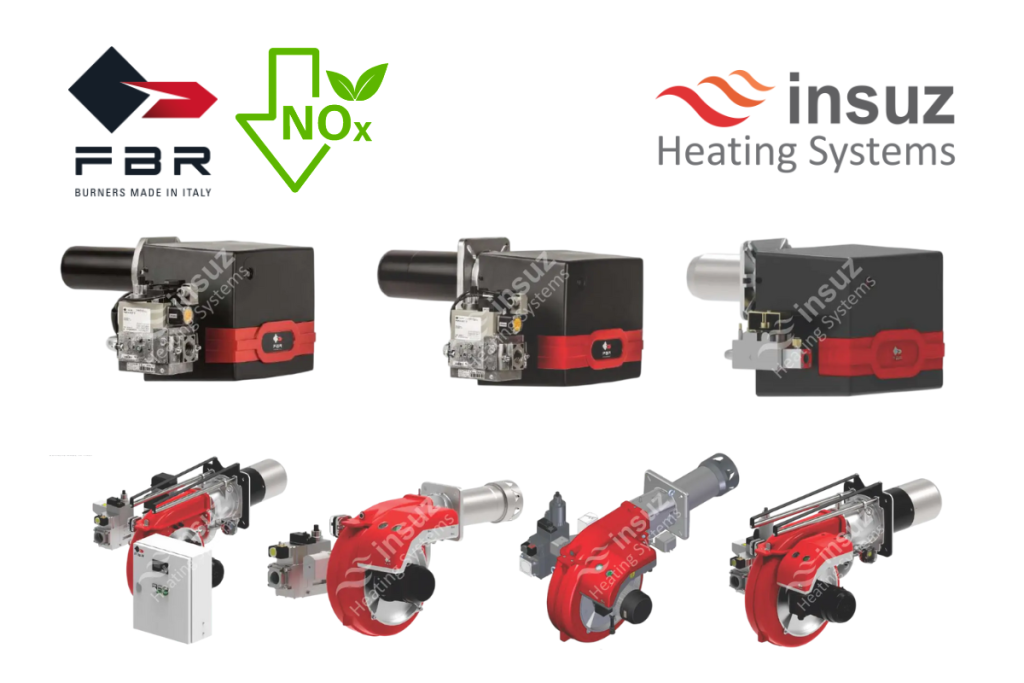
FBR Low NOX Gas Burners
They provide high efficiency and reliability in industrial heating systems. With a wide product range, you can achieve the desired performance using gas, diesel, fuel oil or dual-fuel burner options tailored to different operational needs.
Follow our YouTube channel for more Insuz products
FBR Low NOX Gas Burners – Introduction and Key Definitions
FBR Low NOX Gas Burners are high-performance combustion systems developed to reduce emissions, increase energy efficiency and enhance process safety in modern industrial combustion technologies. These burners feature optimized air–fuel mixture control, multi-stage combustion principles and advanced automation infrastructure specifically designed to minimize NOx (Nitrogen Oxides) formation. Understanding the technical mechanisms of NOx generation plays a crucial role in their design and application processes.
Operating Principle
FBR Low NOX Gas Burners manage the combustion process to minimize thermal and chemical NOx formation. Controlled combustion temperature, optimized excess oxygen ratio and a carefully engineered flame profile are key elements of this process.
Combustion Stages
Combustion typically occurs in three stages:
- Pre-mix zone: Air and gas are partially mixed to reduce initial flame temperature.
- Primary combustion zone: The core flame is formed with controlled excess oxygen.
- Secondary combustion zone: Additional air injection completes the combustion while minimizing NOx formation.
Flame Geometry and NOx Control
Flame length, mixture turbulence and combustion chamber pressure directly affect NOx production. Engineering designs use CFD simulations and test data to achieve the optimal flame structure.
FBR Low NOX Gas Burners – Technical Features
- Stable combustion at low NOx levels
- Modulating operation capability
- High energy efficiency
- Advanced air–fuel ratio control system
- Design suitable for high-temperature processes
- Integrated safety automation
FBR Low NOX Gas Burners – System Design Criteria
Proper burner selection requires evaluation of process needs, boiler type, combustion chamber dimensions and gas pressure levels. FBR Low NOX Gas Burners are widely used especially in high-capacity Hot Water Boiler and Steam Boiler applications.
Low NOX Gas Burners – Air-Fuel Ratio Optimization
To enhance combustion efficiency, O2 trim control, VFD-assisted fan systems and multi-point air inlet structures can be used. These optimizations lower energy costs while reducing NOx emissions.
Low NOX Gas Burners – Energy Recovery Compatibility
FBR burners can be integrated with heat exchanger systems to improve overall plant energy efficiency. For example, using a Plate Heat Exchanger or a Tube and Shell Heat Exchanger in process lines enables waste heat recovery, contributing to enhanced sustainability performance of low NOx burner systems.
FBR Low NOX Gas Burners – Application Areas
Automotive Industry
In automotive production facilities, low-emission burners play a critical role in paint drying ovens, heat-treatment furnaces and component manufacturing lines. With high modulation capability, they ensure process stability and fuel savings in environments where energy costs are significant.
Energy Sector
In energy production plants, low NOx burners are essential to comply with environmental regulations in steam generation, hot water production and thermal process applications. NOx limits are increasingly strict, especially in large-capacity boiler systems.
Construction Industry
In facilities producing building materials—such as drying ovens, lime and cement processes—FBR low NOx burners are preferred due to their ability to withstand continuous high-temperature operation.
Food Industry
They offer value in pasteurization, sterilization, steam production and drying lines by providing low-emission and hygienic operating conditions.
Petrochemical Industry
Low NOx emission is crucial in petrochemical plants for reactor heaters, process furnaces and boiler systems in order to meet environmental standards.
FBR Low NOX Gas Burners – Advantages
- Compliance with environmental regulations thanks to low NOx levels
- Lower fuel consumption
- Long equipment lifespan
- More stable flame characteristics
- Full compatibility with modern automation systems
FBR Low NOX Gas Burners – Disadvantages
- Higher initial investment cost
- More sensitive maintenance requirements
- Sensitivity to combustion chamber dimensions
FBR Low NOX Gas Burners – Comparison with Other Combustion Technologies
- Standard gas burners: Produce higher NOx levels and have lower energy efficiency.
- Premix burners: Provide lower emissions but are not suitable for high-capacity systems.
- Pulverized coal burner: Offers cleaner combustion compared to Pulverized Coal Burner systems.
FBR Low NOX Gas Burners – Installation and Commissioning
During installation, air ducts, gas lines, electrical automation wiring and safety components must comply with international standards. During commissioning, combustion settings (O2 %, CO ppm, NOx ppm), flame stability and modulation response are measured to optimize the system.
FBR Low NOX Gas Burners – Maintenance and Operating Recommendations
- Regular air–fuel ratio control
- Fan and servo motor maintenance
- Flame sensor calibration
- Cleaning of gas filters
FBR Low NOX Gas Burners – Conclusion and Evaluation
Low NOX Gas Burners provide environmentally compliant, highly efficient and reliable combustion solutions for modern industrial facilities. They offer major advantages in reducing energy costs, achieving sustainability targets and improving process quality. For these reasons, low NOx technology holds a strategic position in the future of industrial heating systems.


 Русский
 Türkçe